
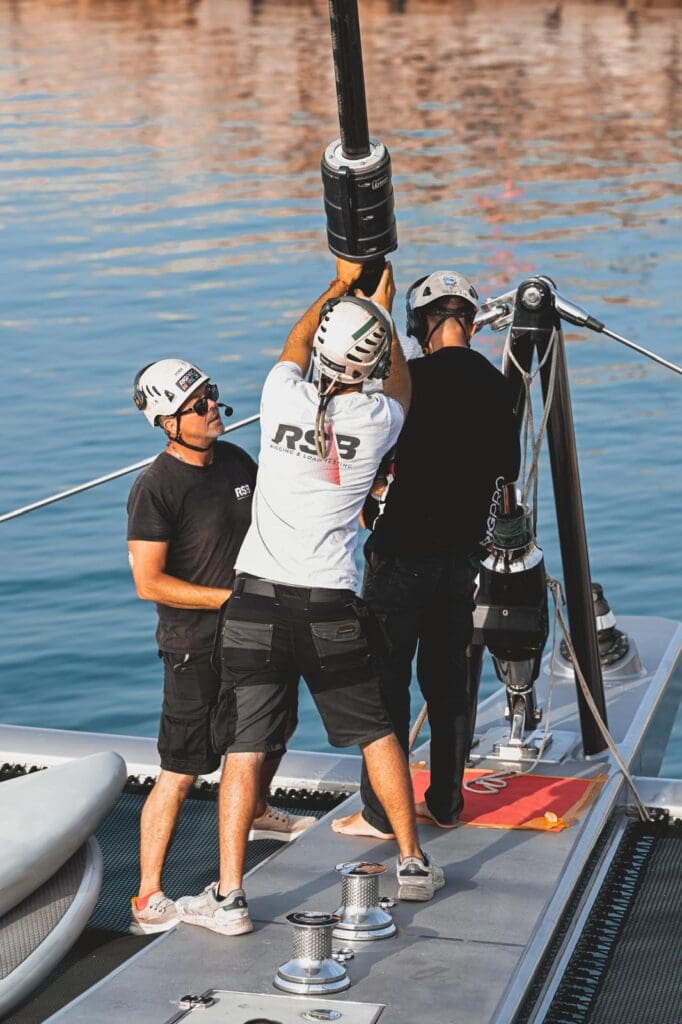
Standing rigging forms the core load-bearing structure of any superyacht rig system. For yachts prioritising performance, reliability, or long-distance cruising, the structural and handling advantages of a composite retrofit are significant.
Delaying the replacement of critical components beyond their safe service intervals risks costly failures and potential loss of insurance coverage. Composite standing rigging delivers engineering reliability along with measurable improvements in tuning, stability, and responsiveness.
Older rods and hardware are prone to fatigue from cyclic loading and vibration, whether under sail, hauled out or simply berthed at the dock. Such failures often occur without warning and can result in sudden, potentially catastrophic loss of support. Retrofitting with modern composite materials offers numerous advantages, outlined below.
Composite Standing Rigging
With a reduction in weight the effect is immediately visible with an increase in righting moment and a potential decrease in the pitching and yawing behaviour of the yacht. This will equate to a more responsive vessel, clearer feedback on the helm and faster acceleration. There is no lag in trim changes, no secondary movement caused by elongation under load, and tuning can be repeated with reliable consistency. For owners and captains competing at the highest level or simply maximising the sailing experience, these benefits are indisputable.
A modern composite retrofit begins with a systematic rig inspection and documentation phase. All elements of the rig are measured to give accurate lengths of stays, spreader angles, rake and prebend figures. The cable specification is driven by precise load calculations along with the appropriate safety factors for each stay while also taking into account the interfacing of the cable terminations/fittings with the spar, chainplates and associated deck fittings.
Some composite systems can be retrofitted to an existing mast without the need to modify spreader ends to accept the cables. Other systems will require modification or replacement of the spreader-ends to accept the new stays.
With new cables delivered to the vessel the mast can be dressed and prepped for the re-stepping operation. Once the rig is re-stepped, it is dock tuned to the loads that the designers supply to the rigger and the sailing trials will be carried out to make any other adjustments to the tune or overall rig set up. All actions are recorded and documented for class and insurance compliance.
A composite standing rigging retrofit can greatly improve the sailing characteristics of a vessel. When properly engineered and executed, the result is a huge reduction in weight aloft and the many positives that come with this that allow both owners and crew to operate with maximum confidence in the vessel.
Conclusion
In summary, investing in a composite standing rigging retrofit is a strategic decision that delivers measurable performance improvements and enhanced reliability. The weight savings aloft improve stability and acceleration while increased rig stiffness allows for more precise sail tuning. Proper engineering, quality components, and dedicated workmanship ensure longevity and safety. For any superyacht serious about racing in the various super yacht regattas around the world this upgrade will definitely help to keep you at the front of the fleet.


