
There was a time when superyacht rigging was viewed largely as a stand alone trade. Replace the wire, service the furlers, tune the rig, step the mast. The work as a superyacht rigger was highly skilled, but relatively contained within the rig itself.
That is no longer the reality of the sector.
Modern superyacht rigging now sits within a far broader operational and technical framework. Here, structural understanding, compliance, safety systems and engineering coordination are as important as the rigging components themselves.
The change has happened gradually. It has been driven by the increasing complexity of yachts and the growing expectations surrounding reliability, documentation and risk management.
Carbon spars, composite standing rigging, high strength low stretch lines and integrated hydraulic systems have fundamentally changed the way loads move through modern sailing yachts. At the same time, vessel structures have become lighter and more complex. They are also less forgiving of incorrect installation practices or poorly understood load transfer.
As a result, rigging work today relies heavily on understanding the interaction between systems, not simply the components themselves.
The performance and long-term reliability of furling systems, captive winches and sail-control systems are influenced not only by the individual components themselves. Instead, they are also influenced by their integration with the mast, chainplates and supporting structure, the fastening methodology adopted, and the cyclic loading conditions inherent to the sailing environment.
This is one of the biggest shifts within the industry.
The role as a superyacht rigger has become increasingly engineering-led
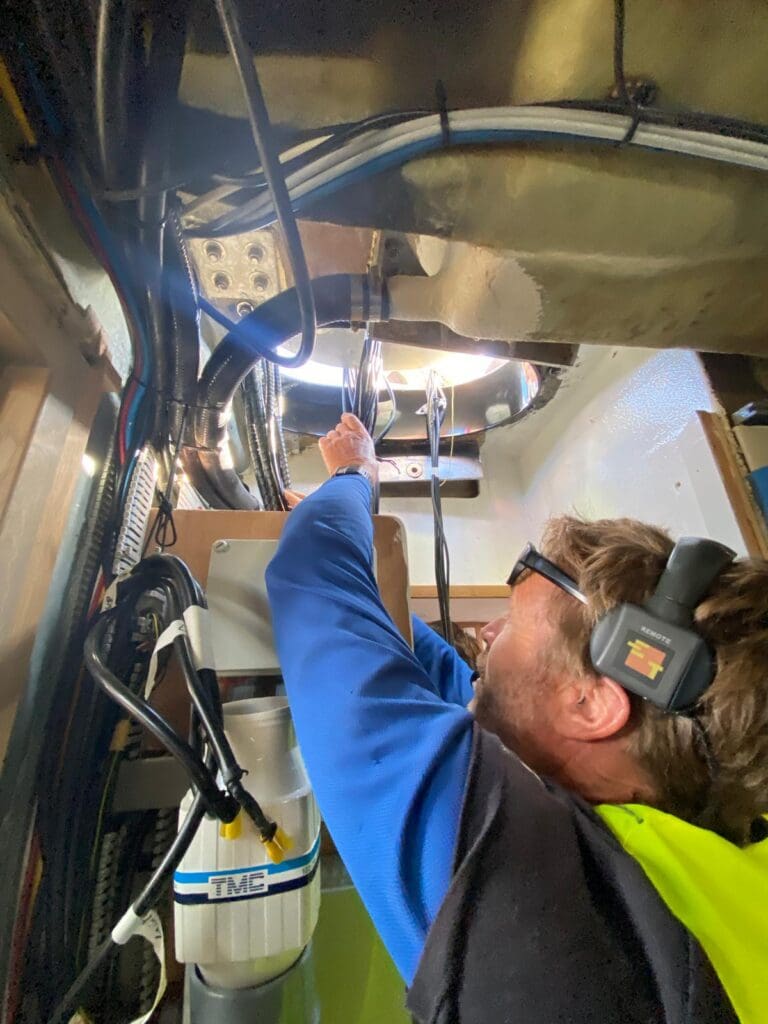
Installation quality now carries the same weight as the component specification itself. A system can pass a load test while still being fundamentally wrong in the way it has been integrated into the vessel. Incorrect backing structures, incompatible materials, poor alignment or incorrect load paths may not present immediate failure. However, they shorten service life and increase operational risk.
The same progression is visible in safety and compliance.
Rigging teams are now routinely involved in fall arrest systems, lifting operations, thorough examinations and load testing programmes that extend well beyond conventional mast and rigging scopes. In addition, Flag States, class societies and insurers increasingly expect documented verification rather than assumptions based on visual condition or previous service history.
That shift has changed the value of inspection work.
Modern inspection is less about identifying obvious failure and more about understanding how failure develops before it becomes visible.
Corrosion rarely begins where it can easily be seen. Similarly, fatigue rarely announces itself early. Many of the most serious structural issues begin within concealed interfaces, loaded connection points or areas where different materials interact under stress and environmental exposure.
This is why deferred maintenance has become a growing focus across the industry. This is not because yachts are poorly maintained, but because operational schedules have become tighter while systems themselves have become more technically demanding.
The challenge is no longer simply repairing failure. It is identifying deterioration early enough to avoid disruption altogether.
That expectation has altered the relationship between yachts and their rigging contractors. Increasingly, owners, captains and management teams expect rigging companies to function as technical partners within the wider operation of the vessel. Yard periods are shorter and scheduling is tighter. As a result, downtime carries greater financial and operational consequences than it once did.
Rigging teams are therefore expected to contribute far earlier in the process. This can be through inspection planning, engineering review, commissioning support or operational risk assessment during refit periods.
Rig stepping illustrates this evolution clearly.
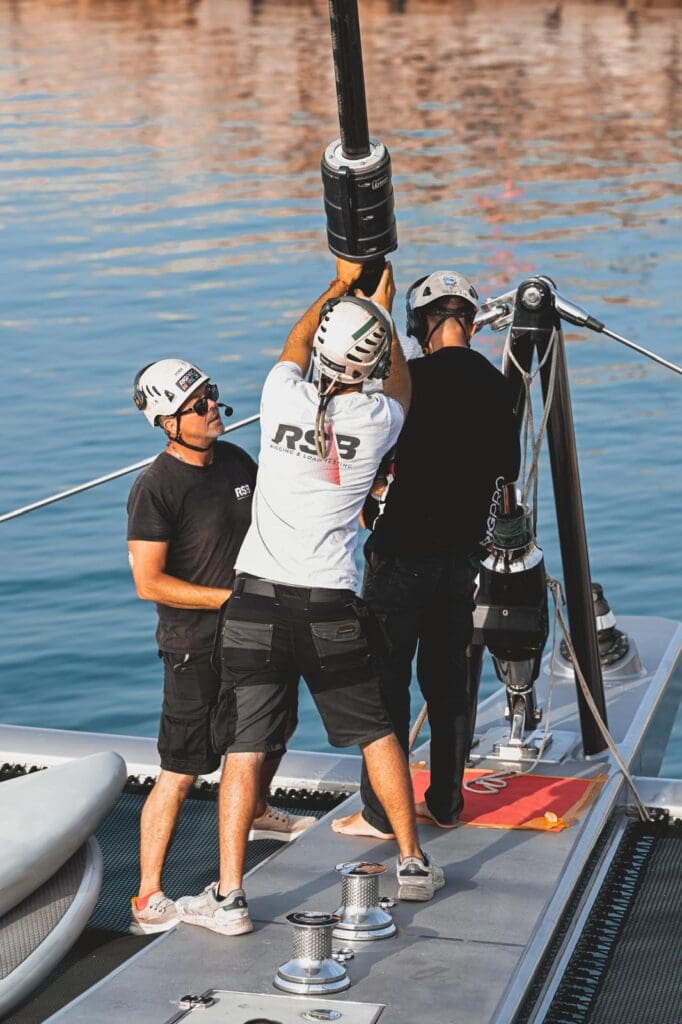
From a distance, it can appear straightforward: crane lifts mast, mast goes in. In practice, it is a highly controlled sequence where communication, alignment and load management all happen simultaneously. The operation depends on constant adjustment, controlled movement and an understanding of how the structure behaves while suspended.
The visible part of the operation is often the simplest element. The complexity sits in the preparation, sequencing and detail behind it.
Even the smallest components demand attention. A dropped washer, incorrectly secured pin or poorly aligned fitting may seem insignificant in isolation. However, within a loaded rigging system, small details quickly become larger problems.
This level of scrutiny now extends throughout the discipline.
The modern superyacht rigger is expected to move comfortably between practical rigging work, technical inspection, structural assessment, certification processes and safety-critical operations. It remains a hands-on profession. However, it is one increasingly shaped by engineering awareness and procedural control.
That evolution is also one of the reasons the sector is attracting increasing interest from younger technicians and marine professionals entering the industry. Few areas within yachting offer such a wide range of technical exposure. A single project may involve rigging systems, composite structures, lifting operations, hydraulics, load testing, fabrication, safety systems and engineering coordination. This often takes place all within the same working environment.
For many, that variety is what makes the role appealing. The learning curve is continuous, and the work demands both practical ability and technical understanding. No two projects are entirely the same, and experience is built across multiple disciplines rather than within a narrow specialism.
What has not changed is the environment itself. Rigging systems still operate under constant load in one of the harshest environments possible. Salt, movement, vibration, UV exposure and cyclic stress continue to test every material and every connection onboard.
The difference today is that the industry understands far more clearly where failures begin and how systems degrade. The industry also understands what is required to manage them properly over the long term.
That understanding has fundamentally changed the role of the superyacht rigger.


